Category: CSS, Javascript, (x)HTML
Coding a website or internet app can be a challenge. CSS (Cascading Style Sheet) comes to the rescue. One of the major enhancements in CSS technology is the Flexbox.
I've always rejected using a CSS Framework. As a website and web applications developer, our staff of designers and coders tried their best to steer the company towards using Bootstrap, a move I regularly rejected.
I'm more apt to use a framework these days. They do make development more rapid than without the framework.
However, I still find most CSS frameworks to be incomplete and close to junk. This category exists to offer some suggestions, code snippets and my opinions.
There are 10 posts in this category:
Friday December 12 2025
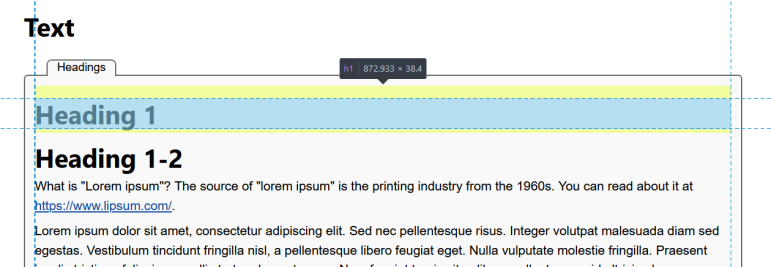
You don't have to search too far to understand the importance of the H1 tag. It's fundamental to good SEO.
Power Digital Marketing says "The H1 tag is the most important main heading on a page because it's the highest heading level tag that shows what your page or blog post is about. As a result,...
Read full post
Friday December 12 2025
As I spend more time writing my own framework, it occurs that it really is the only way to meet your exacting needs.
Approach this as a developer. The first issue is how your project will appear on various browsers. You can't avoid this, it is impossible. You cannot control what browser users will...
Read full post
Saturday December 6 2025
Bulma is a CSS framework that I have used in the past. I was engaged in the framework and developed quite a few websites with the code base, starting with v0.9.4. I did have some concerns ... Bulma is a huge size.
I need to make it clear: I do not use any CSS pre-processor. I use the CDN as...
Read full post
Saturday December 6 2025
There is no way of creating a new CSS framework, classless or class-light, without a thorough knowledge of HTML5.
One aspect of HTML5 is the new structure the specification brings with it. Some, with controversy (or at least confusion).
The new layout semantic...
Read full post
Monday November 24 2025
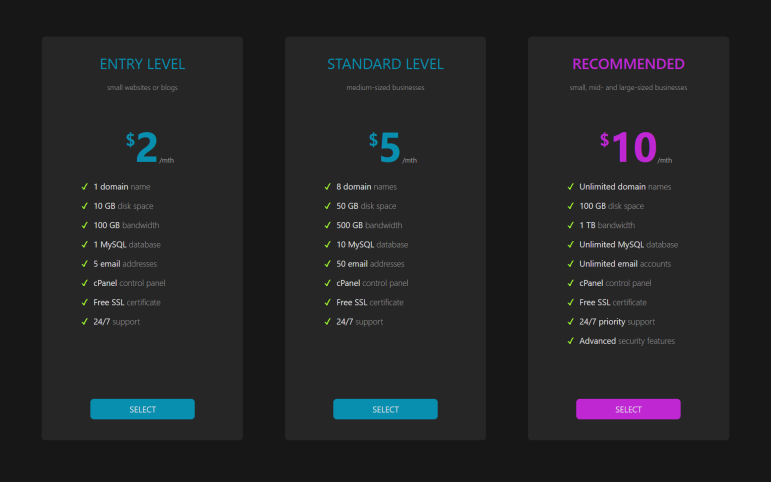
It really is getting easy. The key to going classless is to treat everything as a block.
First, there is the "wrapper" itself. Most of the time that is <section, or <article, or even a <div with a class name something like class="hero-wrapper" ... recognize that?
It's that "wrapper"...
Read full post
Saturday November 22 2025
I stumbled onto a site that featured a responsive horizontal card. The HTML structure for each sample card was a minimum of 458 bytes. The CSS was a total of 116 lines of code.
It was an interesting structure for both the CSS and HTML ... I re factored the CSS as a nested classless structure and...
Read full post
Saturday November 22 2025
Wow! just WOW!
I am pretty much done all the code and creating index and template files. One last step: calculate the overall sizes for raw files, minimified files, and gzip equivalents.
I have everything organized into "classless" and "class-light".
Classless: 37.124Kb raw, 23.985Kb minified,...
Read full post
Thursday November 20 2025
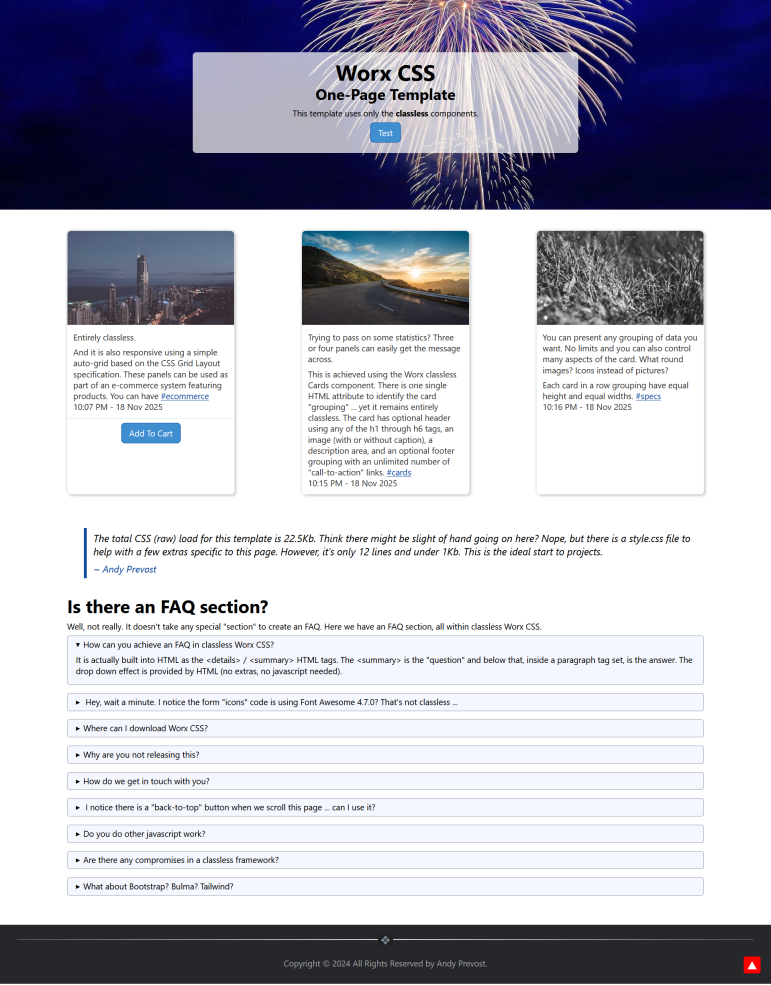
If you do a search on "what is semantic html", you'll end up with quite a few links – most giving examples like <div> <span> <button> <nav> and many more.
Dig a bit deeper though. And ask more questions. In particular, search on HTML attributes. If you include those in...
Read full post
Thursday November 20 2025
The more I spend time coding for HTML attributes instead of classes, the more I like the direction.
Buttons were a lot easier to make classless than I originally thought – plus they fit right in with the "role" attribute, providing an indication for accessibility purposes. Rather than just...
Read full post
Sunday November 16 2025
Is it right?
Can you still call a framework classless if you use data- attributes? or "roll"? That would look like: <div data-grid> and <div roll="grid"> ....
I am going through the process of trying to create a CSS classless framework. I've got some great components already, including...
Read full post