We downsized from a 2500 sq. ft. house to our current home at 1400 sq. ft. That's a major change. I was fortunate to have my brother-in-law (Barry) help me build two lofts at opposing ends of the garage. Both are the full width of the garage, 8 ft deep, and the top is 8 ft. off the garage floor. That means I ended up with slightly less than 4 ft. height for storage space. Getting our boxes and small office furniture up there was a hassle. I ended up damaging my step ladder. It twisted under load.
This worked well for about 10 years. And for those 10 years, we didn't even look at any of the boxes. Likely not needed, right?
Nearing our 11th year anniversary of owning this home, we needed to help a family member move items from a fee-based storage unit.
I expanded the lofts ... connecting both ends together and the full width of the garage. Yes, it's essentially an attic loft.
The first build out (when we first moved in) was over-built. We used 2x10's and 2x8's ... doubled up and supported with 4x4's and 2x4's. The expanded loft is also over-built. I don't want anything to come crashing down. There's a lot of weight up there.
This time around, I wanted a simpler way to get stuff up to the loft. Through Google searches, I found some videos of DIY garage "elevators" that seemed to fit my needs. The lift mechanism is a hoist – typically used as an engine hoist. I didn't like any of the designs. Most relied on the hoist supported by a 2x4 rafter span. The hoist I picked can lift up to 1380 lbs close to 600 kg). I don't expect to have anywhere near that.
The heaviest item, I believe, would be a snow blower. The spec shows that as 285 lbs.
I was able to get a friend, Steve, to help out with some of the heavier tasks.
My design is based on a gantry style bracing system. I positioned a huge beam on top of the bracing system and attached the hoist to the beam. This way the weight being lifted is transferred through the gantry braces directly to the cement floor.
I've now been through two totally different elevator platforms. The first was a measuring mistake that I chose not to fix. The measuring mistake made the size of the platform 28" x 48". Despite the mistake, I was able to work through cleaning the stuff we already had on the loft. More than three-quarters of the stuff we moved from our other house ended up given away or thrown away. We also took the opportunity to go through our receipts, tax returns and other sensitive stuff. That was all put in banker size boxes and shredded. The other paperwork that wasn't shredding material fit into our 95L recycling container – four times over. So heavy that it took two of us to lift it at the local waste and recycling center.
The rest I lined up against one wall. That was our stuff.
I then used my new elevator lift to get all the storage unit contents up in the loft. A few things I noticed that I would change the next time. The platform I designed is not that robust with two problems: racking and lifting un-levelled. I did design a locking system to make sure the platform would remain at the top when the locks were activated.
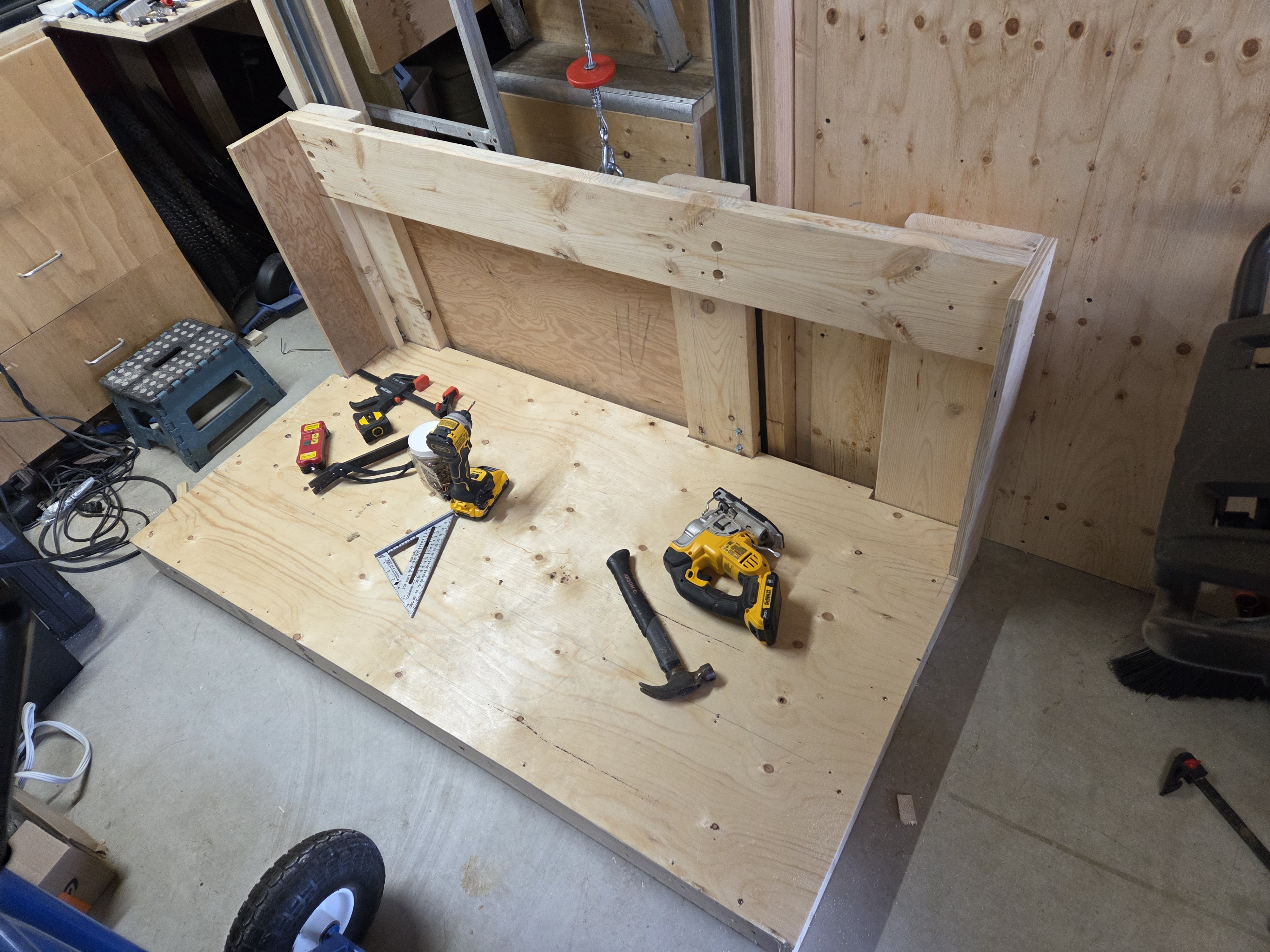
I decided to fix my measuring mistake after all that was done. It was fairly complicated involving structural changes. This time, though, there was stuff I needed to support while the changes were underway. I expanded the platform to 32" x 64". Just the right size for my snow blower.
Here's where the mistakes from the first platform are magnified with larger size and more weight. I went through four iterations of this new platform .. three of those were complete new rebuilds. The first rebuild was to solve a significant racking issue. There were a few tweaks of this second build. The second rebuild was to alter the lifting point of the platform – and move the hoist. I need to point out that the lifting point has to be about mid-way of the width. Otherwise the weight distribution of the platform and stuff being lifted will be severely un-levelled.
Here's one of the first major mistakes. The hoist attaches at the lift point by an eyelet that is 1/2 thick hardened steel and 8" ... that is the entire depth of the 2x6 back element of the platform to lift. I had moved it to the new position ... but needed to temporarily lift the platform before the hoist was moved. So, I used a thick wire (straightened coat hanger) through the original hole, double wrapped, and secured. The hoist hook was connected to that. I lifted the platform to the very top. And it came crashing down the entire 8 ft. A dead weight of about 100 lbs. My wife came running from the house ... fortunately I was not under the platform. I was off to the side.
That platform came apart very fast. I needed to stop patching, and come up with a sturdy design that would not rack and remain level. And that means level across the width and length. Across the width is not that easy. It's a 2x4 platform vertically and horizontally. I have to use ratchet straps to maintain the 90 degree "level" part. Since I didn't move my "gantry" braces, I have a 12" overhang on the one side. In the final build, and to compensate, I "overbuilt" that corner and it is now solid.
I've finished the last build. And, I hate to say it, but I ran into another issue. My new build had a part overhanging that caught on the first time lifting. And it fell skewed a bit, which means it didn't quite go all the way down.
But it does reinforce one major flaw in my original design. I didn't plan for a fall. And twice the platform fell. In both instances, I was not near the platform. But, I could have been. Someone else could have been walking under it.
Any time I work on the platform now I put a 2x4 as a precaution. That's just a temporary fix.
There are videos of other safety devices on similar garage elevators. Roughly half of them are based on commercial elevators and involve some significant costs. They are not really DIY. There are a few other instructional video that feature some type of fall arrestor or fall limiter.
I decided to use two fall arrestors, one on each side of the hoist motor. The spec calls for the fall arrestor to stop at 0.2m – roughly 8 inches. Each fall arrestor has a weight limit of 330 lbs (roughly 150 kg).
I'll update when I get those installed.